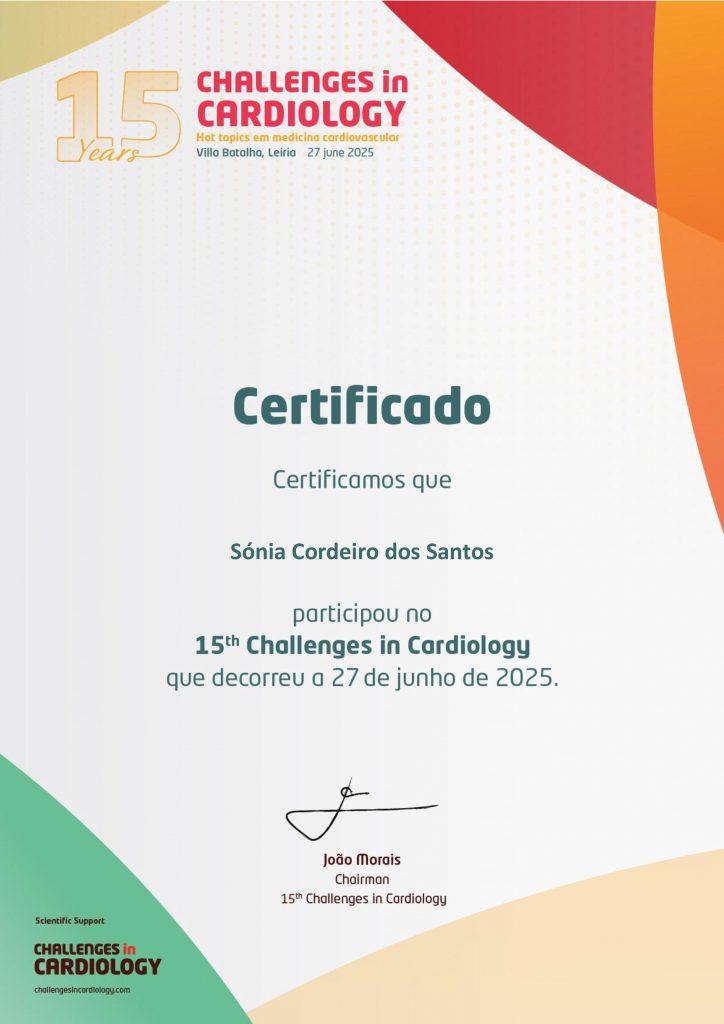
Sónia Santos, a doctoral fellow at ciTechCare conducting research in the field of heart failure, participated in the 15th edition of the “Challenges in Cardiology” congress, held on June 27, 2025, at Hotel Villa Batalha in Leiria. Her participation was made possible through the awarding of one of the ten grants allocated to “Students in the Health Sciences.”
This scientific event, organized by Professor João Morais—former Director of the Cardiology Department at the Local Health Unit of the Leiria Region and researcher at ciTechCare—brought together several nationally recognized experts in the cardiovascular field. The congress promoted in-depth discussions on current clinical and scientific topics with direct implications for medical practice, including arterial hypertension, obesity, dyslipidemia, and vascular risk. Heart failure (HF) was highlighted as one of the central themes of the programme, with a focus on novel therapeutic strategies that have substantially improved patients’ quality of life.
Within the scope of heart failure research, particular attention was given to the urgent need for new characterization and management approaches for heart failure with preserved ejection fraction (HFpEF)—a topic closely aligned with Sónia Santos’s doctoral project, which focuses on data-driven subphenotyping in HFpEF patients. This alignment enabled a deeper exploration of the current state of the art, particularly regarding the integration of emerging therapeutic modalities, functional assessment models, and the clinical applicability of the most recent HFpEF scoring systems, such as HFA-PEFF and H₂FPEF.
Cristina Gavina, the current President of the Portuguese Society of Cardiology, chaired a session dedicated to heart failure, during which emerging strategies for patient stratification and personalized therapy were discussed. Particular emphasis was placed on sub-phenotyping, a topic of considerable relevance to the development of the ongoing doctoral research project. The scientific poster session was also of significant interest, as it provided access to recent data on targeted therapies, such as the use of Tafamidis in cardiac amyloidosis, reinforcing the importance of precise phenotype identification in the context of heart failure.
This year marked the first edition of the event to offer 30 full registration grants: 10 for “Students in the Health Sciences,” 10 for “General and Family Medicine Specialists,” and 10 for “Nursing Professionals with an interest in cardiovascular health.” This initiative aimed to foster the dissemination of scientific knowledge, facilitate the transfer of updated knowledge and promote interdisciplinary engagement across a broad range of healthcare professionals.
The event concluded with a commemorative session celebrating the 15th anniversary of the Challenges initiative, highlighting key contributors, scientific and institutional collaborations, and the event’s evolution over the years.